


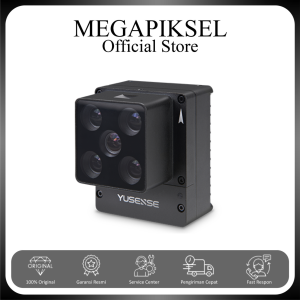
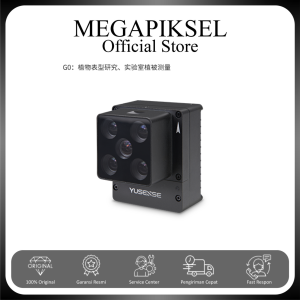
Six narrow-band spectral bands,sapphire optical Windows, large apertures, low distortion, broadband transmission,all-glass lens and an aluminum camera housing.In addition, MS600 V2 has a large dynamic range of intelligent dimming performance, which can meet the application needs of precision agriculture, forestry monitoring, river monitoring, ecological protection, target recognition and other industries.

Product parameters
| MS600 V2 | |
| Sensor | CMOS, 1/3″, 1280 × 960 ( 1.2 MP per EO band) |
| Shutter | Global shutter |
| Digitalizing bit | 12 bit |
| Field of View | HFOV: 49.6°, VFOV: 38° |
| Focal length | 5.2mm (all bands) |
| Fnumber | 2.2 |
| Ground width | 110m×83m per EO band at 120 m (~400 ft) AGL |
| Ground sample distance | 8.65cm per pixel (per EO band) at 120 m (~400 ft) AGL |
| Spectral bands(CWL@FWHM) | 450nm@35nm, 555nm@27nm, 660nm@22nm, 720nm@10nm,750nm@10nm, 840nm@30nm |
| Data calibration and correction | Spectral calibration, Radiance calibration, Geometric calibration and Downwelling light correction |
| Capture rate | 1 capture per second (all bands), 12-bit RAW |
| Storage | SD card, maximum to 128GB, UHS-I Speed Class 3 (U3) |
| Triggering options | Manual capture mode, timer mode, overlap mode |
| API | Open API for image transmission and camera control |
| Interfaces | Serial, 10/ 100/ 1000 ethernet, removable WIFI, external trigger, GPS, SD card |
| External Power | 7V DC to 30V DC |
| Power Input | 8W@12V (including DLS module) |
| Dimensions | 79mm×74mm×52mm |
| Weight | 320g ( Camera&DLS and WIFI Module) |
| Image data | |
| Image format | 16bit TIFF |
| Processing software | Yusense Map, Pix4D, etc. |
| Analysis software | Yusense Map Plus, ENVI, etc. |
| Environment temperature | |
| Operating temperature | -10ºC to +50ºC with airflow > 1m/s |
| Storage temperature | -30ºC to +70ºC |
| Certification | |
| Hardware product | CE, FCC, RoSH |
| Software development | CMMI-DEV v1.3(Staged): Maturity Level 3 |
Note: The standard wavelength allows any combination of the following 17 wavelengths to be customized:410nm@35nm,450nm@35nm,490nm@25nm,530nm@27nm,555nm@27nm,570nm@32nm,610nm@30nm,650nm@27nm,660nm@22nm,680nm@25nm,720nm@10nm,720nm@15nm,750nm@10nm,780nm@13nm,800nm@35nm,840nm@30nm,900nm@35nm.
Typical application

By using vegetation factors such as NDVI and LAI, quantifying the consistency of vegetation canopy status at different spatial scales, and using characteristic spectra of vegetation in different health states to quantitatively assess vegetation growth,which can provide data support for irrigation, fertilization, plant protection, yield evaluation and other work.
 Using spectrum and texture information to achieve efficient suppression of the environmental background of soil, withered grass and other objects and high-precision identification of color-change pine. By accurately extracting the location, spatial distribution and canopy area of color-changing pine trees, we can provide data support for the management of diseased trees.
 By referring to the evaluation standard of surface black and smelly water, using the characteristic spectrum of black and smelly water to construct the classification index to achieve black and smelly water classification inversion and spatial information statistics. This technology can assist in analyzing the influence of domestic sewage and industrial wastewater on surrounding water, and finally help pollution source investigation and water environment assessment.

Reviews
There are no reviews yet.